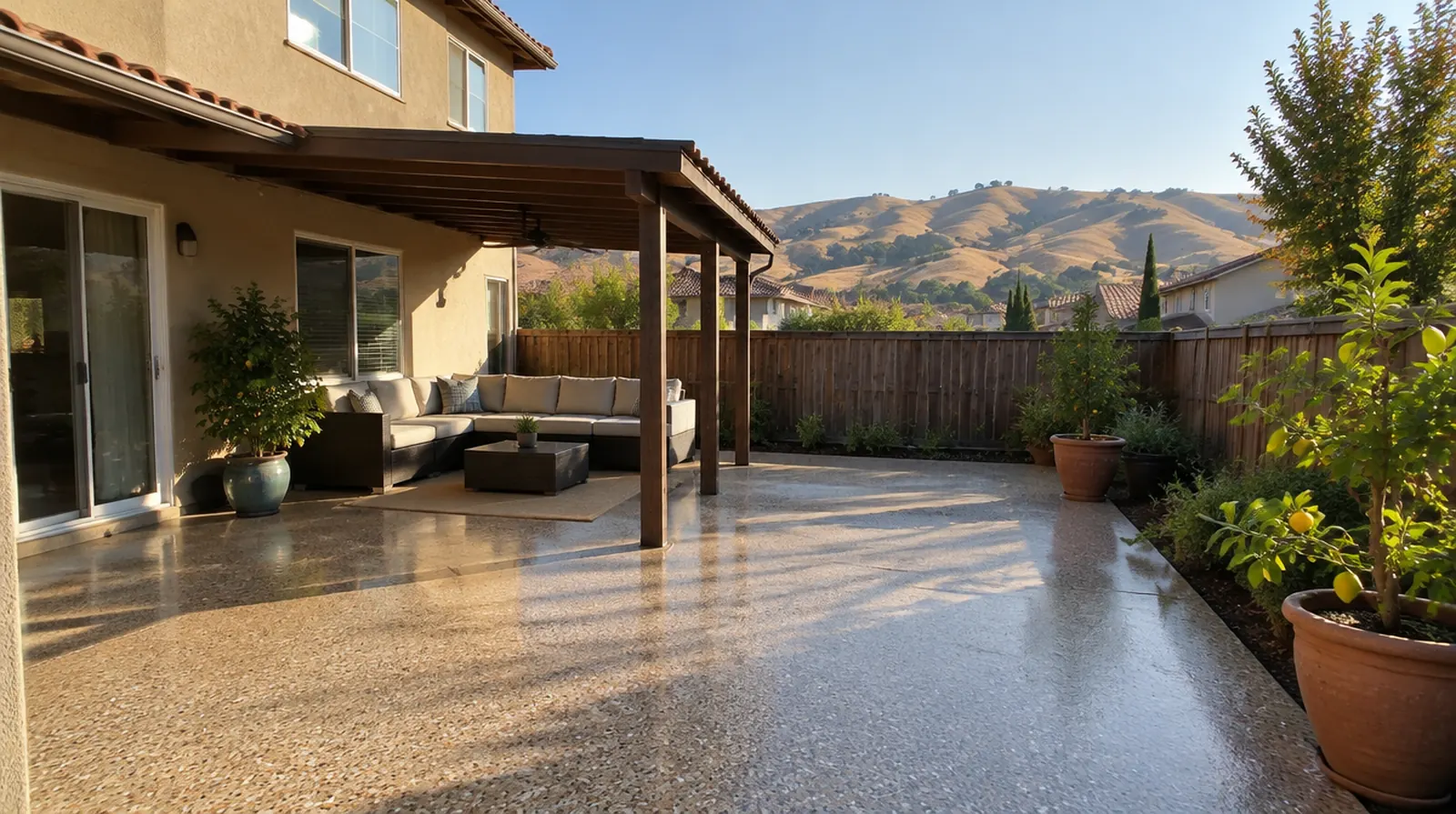
Patios we see in Union City
Union City grew from the old towns of Alvarado and Decoto into the suburban city it is today, and most of its homes were built from the 1960s through the 1990s. The backyards reflect when they were built. Older single-story ranches often have exposed aggregate patios that have gotten rough and stained. The two-story tract homes from the 1980s and 1990s usually have a plain broom-finished slab off the slider, sometimes extended later with a second pour. Newer townhomes have small patios that see heavy use.
A patio coating gives any of these a fresh, uniform surface. It seals the concrete against spills and stains, adds slip resistance and makes outdoor living space feel like part of the house.
Coating over exposed aggregate
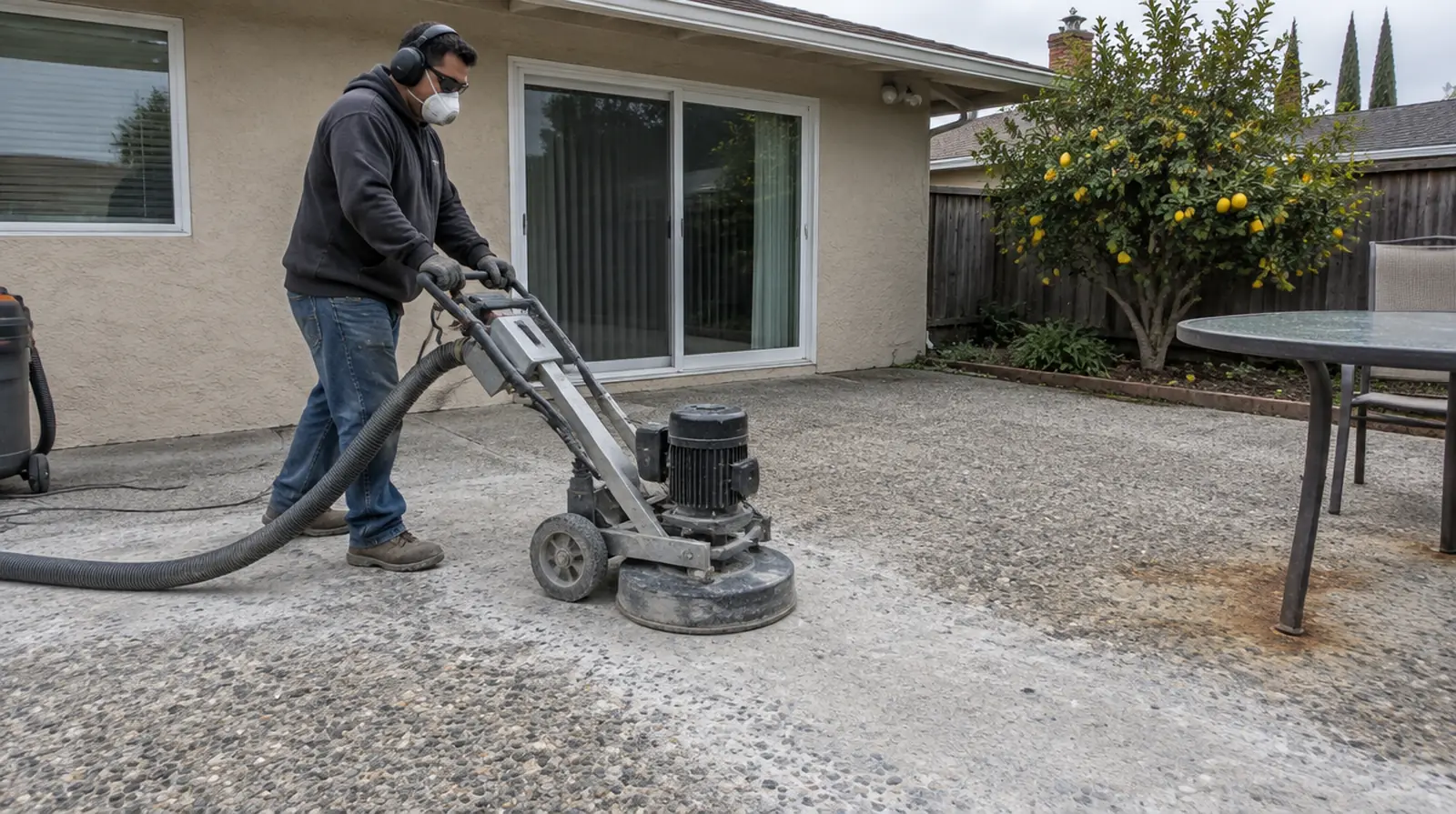
Exposed aggregate looks good when it is new but gets rough, dirty and uneven over the years. Pebbles loosen and pop out, and the low spots between stones hold dirt. To coat it, we grind the surface flat, cutting the tops of the pebbles, then fill the low areas so the coating goes on smooth. It takes more prep than a broom-finished slab, and we include that in the quote up front. The result is a patio that is much easier to sweep, wash and walk on barefoot.
Built for the East Bay climate
Union City has mild weather most of the year, with dry summers, a cool breeze off the Bay most afternoons and rain mostly from November through March. That is good news for patios, but the sun is still strong in summer and fall. We use UV-stable polyaspartic topcoats outdoors, not indoor epoxy, so the color does not yellow or chalk. Light and mid-tone flake blends stay comfortable and hide dust and leaves.
In winter, patios under trees or against a north wall can stay damp and grow moss. A sealed, textured surface rinses clean and stays grippy when wet.
Cracks and ground movement
Much of the flatland in this part of the East Bay has clay soil that swells when wet and shrinks in summer, and the Hayward Fault runs along the hills right above the city. Cracks in patios are common. We fill stable cracks before coating so they disappear under the finish. Cracks that keep moving may show through again over time as fine lines, and we tell you which ones to expect that from. Slabs that have dropped or tilted toward the house need to be fixed before any coating.
How the job goes
- We protect doors, walls and plants, then grind the slab with vacuum dust collection.
- Cracks and chips are filled. Grease and rust spots are treated so they will not bleed through.
- A base coat goes down, followed by a full broadcast of colored flake.
- Loose flake is scraped and vacuumed, and a clear topcoat with anti-slip grit is rolled on.
Most patios are finished in one day. You can walk on it the next day and put furniture back after a day or two.
HOA neighborhoods
Some Union City HOAs have rules about visible exterior finishes. Backyard patios are usually not an issue, but front patios and entries may need approval. We can give you sample chips and a written description of the product for your HOA.
Other services
The driveway can match with our driveway coating. For a clear protective finish, see concrete sealing, and for pools, pool deck coating.
Patio coating questions
Can you coat a patio that was extended with a second pour?
Yes. We grind the seam flush and treat the joint so the two sections look like one surface.
Is it OK for a barbecue?
Yes. Grease wipes off a coated patio much more easily. Use a mat under a smoker or a grill that drips a lot.
Do you work in Fremont, Newark and Hayward?
Yes, along with Castro Valley and nearby Alameda County cities.
Price your patio coating
Call (510) 892-5684. Tell us about the patio and send a photo if you can, and we will set up a time to measure.